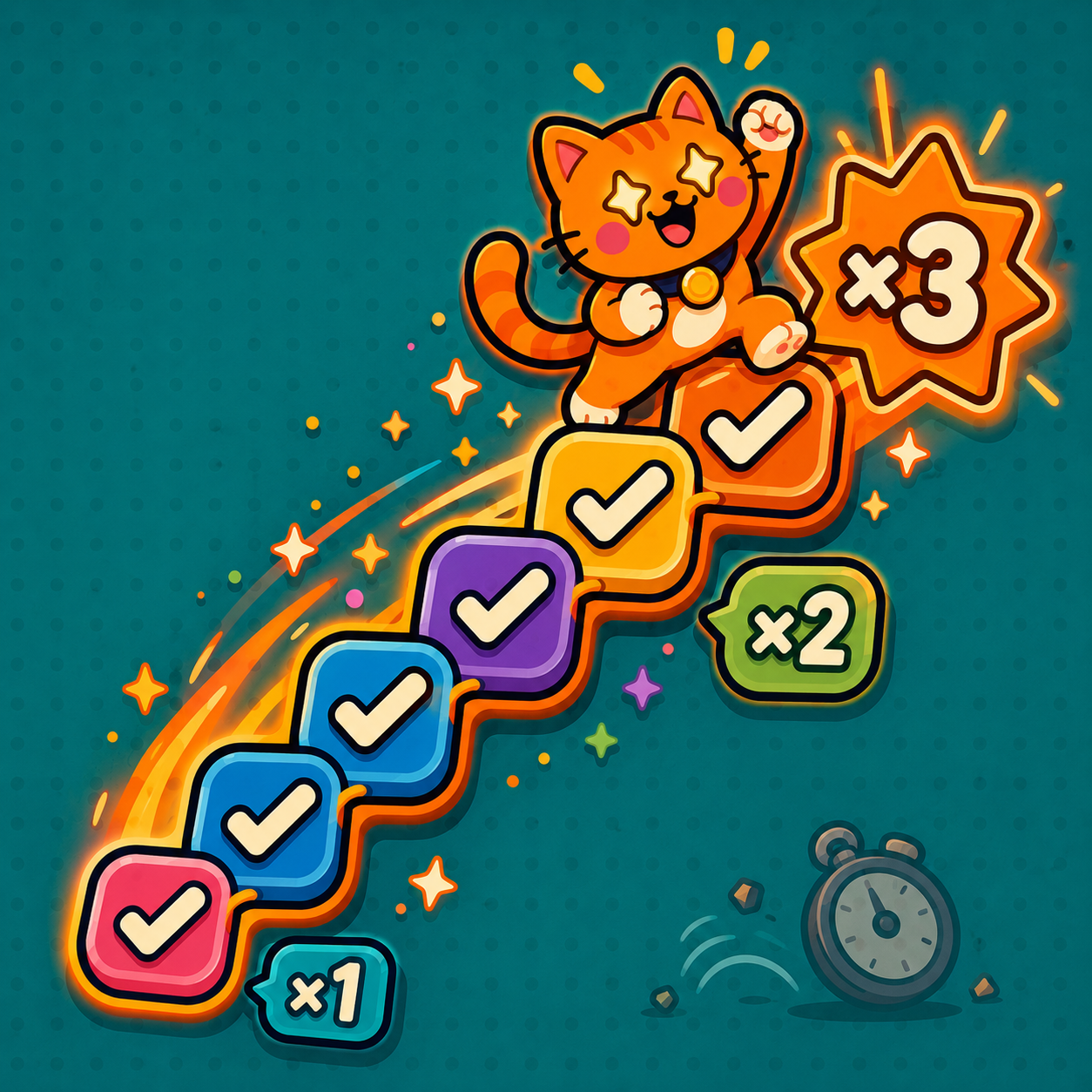
Most quiz games are secretly reflex games. Answer in half a second and you bank a pile of points; take your time and you're punished for it, even when you're right. It turns trivia into a tapping contest, and quietly tells anyone who likes to think that they're playing wrong. Quizzer doesn't work that way — and the line that surprises people most is this: answering in 0.5 seconds and answering in 14 seconds earn exactly the same points.
01The clock is pressure, not currency
The countdown on your screen is real, and running out of it is fatal. But within the deadline, it pays nothing. There is no hidden speed multiplier, no “answered in under three seconds” bonus, nothing tucked behind the timer. The seconds remaining are shown to you for drama and printed in the recap — but they never touch your score.
What decides matches isn't something you race. It's something you build — your streak.
02A correct answer is worth one point — plus your streak
The base is almost comically simple. Get a question right, on time, and it's worth 1 point. Get it wrong, time out, or answer too late, and it's worth 0. That's the entire base — no asterisks.
The interesting part is the word plus. On top of that base point you add your streak bonus — and that's where matches are won and lost.
03The streak is the whole game
Your streak is simply how many questions you've answered correctly in a row this match. It starts at zero and climbs by one with every correct answer. The rule you can do in your head: the Nth correct answer in a row is worth N points.
| Correct answer in a row | Worth | Running total |
|---|---|---|
| 1st | 1 | 1 |
| 2nd | 2 | 3 |
| 3rd | 3 | 6 |
| 4th | 4 | 10 |
| 5th | 5 | 15 |
Watch how fast that compounds. Five correct answers in an unbroken streak score 15 points. Now picture an opponent with identical accuracy — also five right — who slipped once in the middle and reset: their runs might be 1 + 2 + 3 on one side and 1 + 2 on the other, just 9 points. Same knowledge, six points apart. Consistency isn't a tiebreaker in Quizzer; it's the main event.
04Build a run
Play it out. Tap Correct to extend your streak and watch each answer pay more than the last; tap Wrong to feel the reset. Arm Double Down before a tap to bet that one answer — best saved for when your streak is already tall.
05A miss doesn't cost a point — it costs your momentum
This is the part that changes how you play. When you get one wrong, you don't just score 0 on that question — your streak resets to zero, and your next correct answer drops all the way back to being worth 1 again.
You're sitting on a seven-question streak, about to score 8, then 9, then 10.
One careless miss and you're back to scoring 1. That single mistake didn't cost one point — it erased the next several. This is why a steady player so often beats a brilliant-but-reckless one.
Brilliance gets you the high streak. Only nerve keeps it.
06So what does the clock do?
The timer matters for exactly one thing, and it's binary: answer in time, or score nothing. You get 15 seconds per question, plus a small grace window on top so a momentary lag spike doesn't rob you of a correct answer. Slip past that and even a right answer counts as wrong — 0 points, streak broken.
But within the deadline, the clock is flat. Fast and slow pay the same. Those 15 seconds are a gate you have to get through, not a dial that pays out more for hurrying. So take the time to actually read the question — the only thing rushing earns you is mistakes, and mistakes cost streaks.
07Double Down: one swing, pick your moment
You get one special move per match: Double Down. You don't arm it ahead of time or announce it — you attach it to an answer as you submit, betting on that one question. If your answer is correct and on time, Double Down doubles the entire value of that question — base point and streak bonus together.
That “together” is the whole strategy. Double Down isn't a flat bonus; it's a multiplier on whatever the question was already worth, so its value depends entirely on when you play it:
- Spend it on a cold opening question worth 1 point, and you've turned 1 into 2 — a yawn.
- Spend it on the fifth answer of a streak, already worth 5, and you turn 5 into 10. Same move, five times the payoff, purely because you waited for your streak to grow tall.
The catch keeps it honest. Double Down on an answer that's wrong or late and you score 0 and the move is gone for the rest of the match — burned on nothing. (One mercy: a pure timeout, where you never commit an answer at all, doesn't consume it.) So it rewards two things at once — knowing the answer cold, and having the patience to hold your one swing until it's worth taking.
08Why it's built like this
Add it all up and the message is deliberate. Quizzer rewards what you know and how steadily you can hold it together, not how fast your thumbs are. That's a quieter kind of skill, and a fairer one. It doesn't hand the match to whoever has the newest phone or the fastest connection — it gives the careful, knowledgeable player a real path to win, and makes a long unbroken streak feel exactly as good as it should.
So next time the clock is ticking, don't rush. Read the question, trust what you know, protect your streak — and keep that one Double Down in your pocket until the moment it's worth ten.
A correct, on-time answer is worth 1 point plus your streak bonus, so the Nth answer in a row scores N points — five in a row is 1+2+3+4+5 = 15. Speed earns nothing: answering in half a second or fourteen pays identically, and the 15-second clock (plus a small grace window) is just a pass/fail gate. A wrong, late, or timed-out answer scores 0 and resets your streak to zero, so a single miss erases the tall scores you were about to bank. Once per match you can Double Down, doubling a whole question's value — trivial on a 1-point opener, huge on a 5-point streak answer — but a wrong or late Double Down scores 0 and burns the move. Speed was never the point. The streak is.